Let’s be honest. Sending the entire team to wherever production is happening is not always realistic. Schedules stack up. Budgets get tight. And Springfield, MO (God bless her) isn’t high on most folks’ travel list. That is exactly why we built a system for remote tabletop film production at Claro Studioworks.
This isn’t a laptop with a Zoom Pro plan pointed at set. Or FaceTiming on the art director’s iPhone saying “can I see that?” This is a purpose-built workflow that allows producers to actively participate from wherever they are, with real control over what they are seeing and how they engage.
If you’re the producer shepherding a project through post, you shouldn’t feel detached from what’s happening on set. Remote production should still feel like production. You should still feel the rhythm of the day. That’s what we were trying to preserve when we built this.
If you are new to how we approach tabletop effects in general, you can get a sense of our engineering mindset in this article on Intro to Tabletop SFX Engineering: 6 Basic and Reliable Rigs. That same thinking is what shaped this remote system.
Before shoot day
Ahead of any remote tabletop film production, you will receive an email from me with three links.
The first link opens your control panel. (You’ll need Google Chrome.) I generate a temporary access code and you enter it. The code is valid for five minutes, which is the only time-sensitive part of the entire process. Once you’re in, you’re in.
The second link is your live room. Think of it like a web conference. You can turn your camera on or off, mute yourself, or simply monitor. You can share this link with anyone on your team who needs eyes on the shoot. Agency creatives, client, post. Everyone can join.
If your client wants to pop in for a specific shot and then bounce, they can. If your creative director wants to sit quietly and observe lighting adjustments, they can do that too. It’s flexible to how people actually behave during production.
The third link is your proxy drive. That is where footage selects will land during the day.
Inside the Control Panel
When you enter the control panel, you will see two camera options.
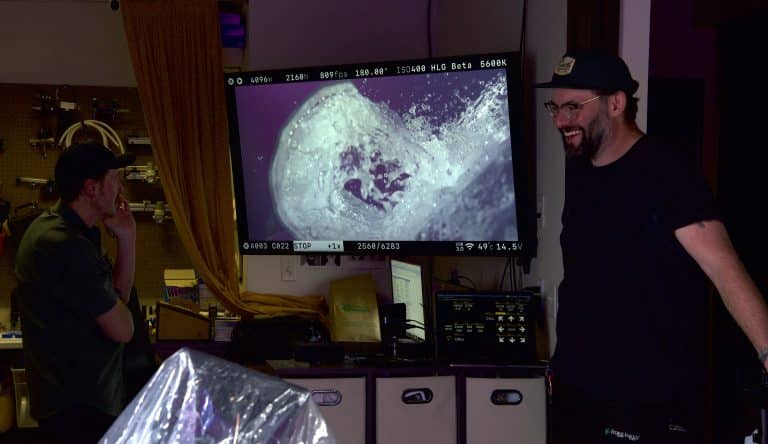
Camera A is the hero camera on set. This is the actual production camera where you’ll see a live view or playback. If we just ran a take, you are seeing exactly what we are seeing at the camera station. Low-latency ensures very little lag between what the camera operator sees and what you see. If something splashes unexpectedly or performs better than expected, you’re reacting in the same moment we are. This is a critical piece of remote production that keeps approvals tight and avoids secondhand descriptions.
The second camera is the ceiling-mounted PTZ. This is your overhead view of the studio. You can pan, tilt, and zoom using the on-screen arrows. If you want to check how a special effect rig is behaving or how lighting changes are affecting the set, you can move the camera yourself. I’ve installed location presets to make things easy and, if you ever get disoriented, hit the “Home” button to snap back to a wide of set.
No more waiting anymore for someone to narrate what happened – you’re looking at it in real time.
Need to Pause and Talk?
There’s a call button on the control panel, and yes, you are absolutely allowed to use it.
When you press it, network-attached lights around the studio light up. That’s my cue to stop and switch things to a front facing camera, turning it into a web call. Turn on your camera, unmute yourself, and let’s hear what you’re thinking. Whether it is a lighting tweak, a prop shift, or a gut check before we roll, we can sort it in real time.
Then we get right back to it.
It starts as a live stream, but it can become a conversation instantly. That flexibility is one of the most important parts of successful remote tabletop film production.
PRoxies in minutes
We shoot tethered on our high-speed system. As soon as we cut, I can trim clean in and out points and export a proxy into a watched folder. From there it automatically syncs to your drive link. No end-of-day transfers. No mystery timelines.
In testing, clients were seeing proxies about two minutes after cut.
So while we are resetting a rig, reloading a special effect, you’re already reviewing the last take. You can confirm performance, flag details, or say “that’s the one” before we roll again. The day keeps moving and energy stays up. That energy changes the shoot day. Instead of stacking up questions and reviewing everything at wrap, you are responding shot by shot. Approvals and notes are clearer. And everyone leaves knowing where things stand.
If you’re curious about the kind of rigs that benefit from this speed, take a look at Inside the Lab: 5 New Tabletop SFX Rigs from Claro Studioworks. Many of those builds were designed with repeatability and quick resets in mind, making them a perfect fit to re-run takes remotely.
Built for How We Actually Work
This setup is about flexibility.
If you can be here in person, awesome. If you can’t, you still have control and visibility on shoot day. It’s perfect for teams to join by clicking a simple URL and people can drop in and out throughout the day. One person drives the control panel at a time, while everyone else simply monitors.
If your schedule pulls you into another meeting for an hour, you can step away and come back without missing the arc of the shoot. If a stakeholder wants a quick look at a hero moment, you can send them the link and let them see it for themselves. Remote tabletop film production adapts to the reality of how agencies and brands operate now.
For a broader look at what we offer beyond remote capability, you can explore Claro Studioworks’ Service Offerings.
Why We Built It
We built this system because it solves real problems. Flights get canceled. Budgets shrink. Two shoots land on the same week. Someone gets sick. Production doesn’t slow down just because logistics get messy.
Good work happens when communication is tight. Remote production is our way of keeping that communication tight even when geography is not on our side. It isn’t about replacing being here in person. When you’re here, we’ll hand you a coffee and show you the monitor. When you’re not, you’re still engaged in the process.
If you have questions before we go into production together, I am happy to walk through the system live. Otherwise, when shoot day comes, you’ll have the links and we’ll get right to work.
Looking forward to shooting with you, wherever you are.